Aes Crypter Vault

The simplicity of the Lite version, with the power of a new application packed with unique features — running effortlessly on Windows with outstanding performance. 

Aes Crypter Vault

Aes Crypter Vault is the ultimate evolution of the Aes Crypter product line—a powerful, efficient, and feature-rich utility for encrypting, decrypting, and computing file digests using high-speed block cipher algorithms. Fully compatible with Windows, it delivers industrial-grade encryption and compression through a sleek, user-friendly drag-and-drop interface.This brand-new edition has been completely rewritten in modern C++23, making full use of advanced concurrency models and Intel® Threading Building Blocks (TBB) to unleash massive performance gains. Vault is specifically engineered to outperform the already-capable Aes Crypter Professional, offering dramatically reduced processing times and lower system resource consumption.

Performance Matters

Aes Crypter Vault introduces a next-generation asynchronous file writing engine. Unlike traditional linear processing, this engine encrypts file chunks concurrently while asynchronously writing completed chunks to disk—eliminating bottlenecks and ensuring sustained high throughput even on very large files.

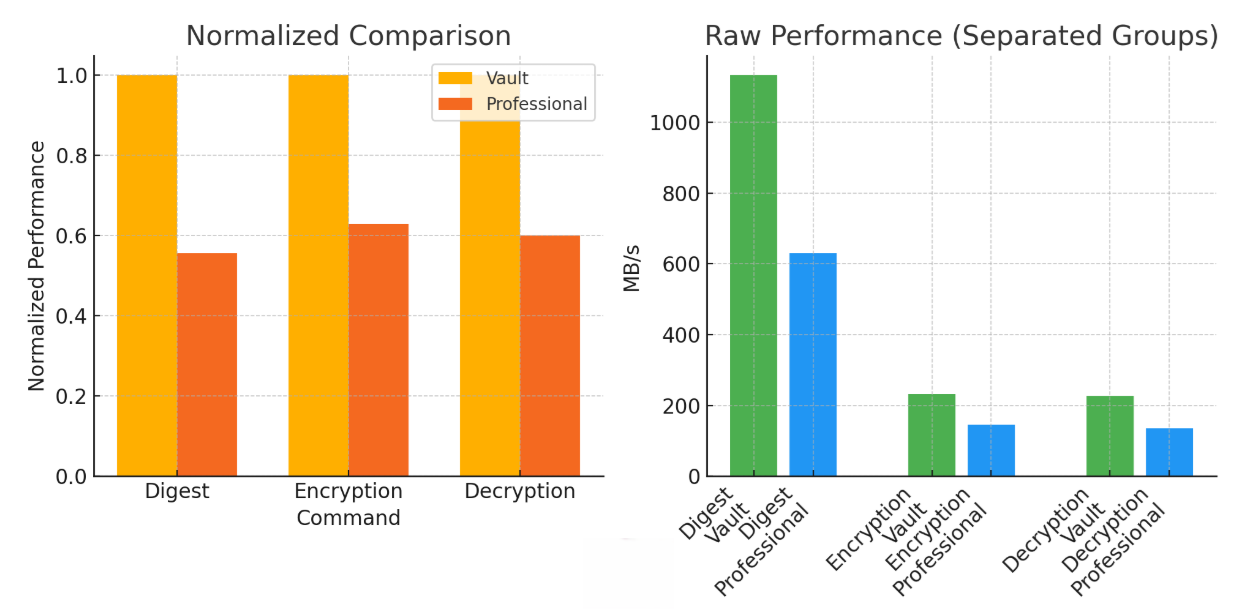
Example Benchmark:

The result? Aes Crypter Vault is consistently 1.5–2x faster than the Professional edition across digest, encryption, and decryption workloads.

Effortless Operation

Getting started is easy:

  1. Launch the application.
  2. Enter your encryption password.
  3. Drag and drop files or folders into the Vault interface.
  4. Let Vault do the rest—automatically and efficiently.

Exclusive Innovations

No Longer Distributed

Aes Crypter Vault can no longer be purchased or downloaded, neither from the Microsoft Store nor from this website. The last version is 2.5.0. Copies already installed keep working, but no further updates will be released.

Visual Learning via Online Help

To help you make the most of all its features, Aes Crypter Vault includes a rich, video-based help system, accessible online. Whether you're a first-time user or a seasoned IT professional, you'll find clear, step-by-step instructions on how to encrypt, decrypt, configure pipelines, and optimize performance.

Why Aes Crypter is no longer available

Full features list Description
Encryption algorithms AES, Serpent, Twofish, Mars, RC6, Aria, Camellia, ChaCha, Salsa20, XChaCha20, XChaCha20-Poly1305, ChaCha20-Poly1305, XSalsa20.
Cipher modes CBC, CFB, OFB, CTR, GCM, EAX (ECB: decryption of older files only).
Pipeline-based engine Customizable & user-defined operations per single file chunk (default 6 MB, adaptive for small files).
Configurable pipeline editor Drag-and-drop UI to build ordered pipelines using digest, compress, encrypt, decrypt, and dummy operations.
Digest support CRC32, SHA1, SHA256 (default), SHA512, SHA3-256, SHA3-512, Shake-128, Shake-256, Whirlpool, Tiger, RIPEMD-128/256/320, BLAKE2b, BLAKE2s, BLAKE3
Compression algorithms Gzip, bzip2, lzma, zstd with selectable compression ratio.
Embedded comments Optional user-provided notes saved inside encrypted files.
Encrypted File inspection Read structure, pipeline, KDF and metadata (chunk size, mode, etc.) without decrypting the data (the password is required).
Encrypted File validation Check if a file is valid and decryptable with the current pipeline and password.
Multithreaded core Optimized with Intel TBB for dynamic load balancing across threads. Requires a modern 64-bit Intel or AMD CPU with AVX2 instruction set support.
Asynchronous writing engine Encrypts and writes chunks in parallel to avoid I/O bottlenecks.
KDF - Key Derivation Function Argon2id (RFC 9106; t=3, m=64 MiB, p=1) for new files, with a 256-bit random salt per file. Files written by 2.3.0 (Argon2id t=2, m=19 MiB) and by 2.2.0 or earlier (PBKDF2-HMAC-SHA3-512) are still decrypted.
Authenticated file format File format v2 (since 2.4.0): separate keys for every purpose and chunk, an authentication tag on every chunk and on the metadata. Any change to an encrypted file is detected and the file is refused; a wrong password and a damaged file are reported differently. Files written by 2.4.0 or later cannot be read by 2.3.0 or earlier.
Verified, safe writes Every encrypted file is read back, decrypted and compared with the original before the original is removed (can be turned off). Output goes to a temporary file and takes its final name only when complete: an interruption or a full disk never leaves a half-written file, and an existing file is never replaced unless you ask for it.
Password generator Generates strong passwords with entropy meter and character set configuration.
UUID filename masking Automatically rename files using UUID during encryption to obscure original names.
Filename metadata Preserves original name and timestamp inside the encrypted file.
Secure wiping Multi-pass overwrite (user-defined number of passes) with fresh random data on every pass, then the file is truncated and deleted. On SSDs and some file systems the drive may keep copies of old data that no software can overwrite.
File filtering Regex-like pattern matching for include/exclude filters.
Logging Four-level event logging for operations and errors.
Filesystem support Fully compatible with all Microsoft Windows file systems, including FAT16, FAT32, exFAT, and NTFS
Compatibility with Aes Crypter free edition Cannot decrypt files encrypted by Aes Crypter Lite or Aes Crypter Professional editions.
Architecture Supports 64-bit. Runs on Windows 10 and 11.
Interface GUI/CLI Both GUI and CLI version (aescli.exe)
License Paid application, no longer distributed (last version 2.5.0). Copies already installed keep working; no further updates will be released.

Minimal Operating System requirements

Requires Microsoft Windows 10 or 11. Fully compatible with 64-bit architectures

Minimal memory requirements

Requires at least 8 GB of RAM for optimal performance during encryption and decryption. A 64-bit CPU with AVX2 instruction set support is mandatory

File System requirements

Fully compatible with all Microsoft Windows file systems, including FAT16, FAT32, exFAT, and NTFS.
A mounted read/write file system is required to save encrypted files.